Monday, November 15, 2010

Udaipur


Friend and fellow Amul ice cream lover Zirong and I went to Udaipur this weekend. Udaipur made the number one place in India to visit in Lonely Planet's second last update and it is described as Rajasthan's, perhaps India's, most romantic city. How they reached this conclusion is beyond my imagination and apparently the description no longer fits as Udaipur is now not even to be found among the highlights in LP's 2009 version.

Something must have happened during this time, but still I had got very positive reviews from some of my fellow exchange students. I admit I had some high expectations. Maybe it is because I am not in my most romantic mood at the moment, but I must say I was rather disappointed. There is very little genuine atmosphere left, as often happens when busload after busload of Western middle-aged tourists swarm the place. For James Bond fans there is the white cake palace in the middle of Lake Pichola known from Octopussy, dare I say one of the highlights of the Roger Moore era. The town is immensely proud of this connection with at least two restaurants claiming to show the movie every night. There are also the fairly overrated City Palace, which was drowning completely in tourists (maybe we should not have gone there on a Sunday, I know...) and some narrow, nice streets with unfortunately too many too touristy shops. One fun part, though, was the folk dance and puppet show we went to in the evening (Rajasthan is apparently famous for puppets). Also, the stone carvings of the Jagdish Temple were pretty impressive.

The return bus trip proved to be far longer than acceptable with the bus regularly having to stop to cool down the engine. Just to make it even a little bit longer, it also stopped for lunch... It felt good to get out of campus, though!

Sunday, November 7, 2010

Celebrating Diwali


Yesterday saw the celebration of Diwali, the festival of light. It is apparently celebrated in remembrance of the god Rama returning from 14 years of exile together with his wife Sita. To show their happiness, the villagers, according to tradition, lit candles everywhere, a custom still very much adhered to among modern Indians. The goddess of wealth and happiness, Lakshmi, is also celebrated during this festival, which mostly resembles a mix of Christmas and New Year in Western tradition. It is a festival of joy, happiness and kindness. Lit candles, firecrackers (loads and loads of them, preferably at 3 am...), the occasional exchange of gifts and dining with family are important parts to it. Since our families for obvious reasons are not present, your fellow dorm mates will have to double. Activities yesterday once again showed the very likeable Indian habit of actively including their foreign peers in activities important to them, something which I found quite moving.

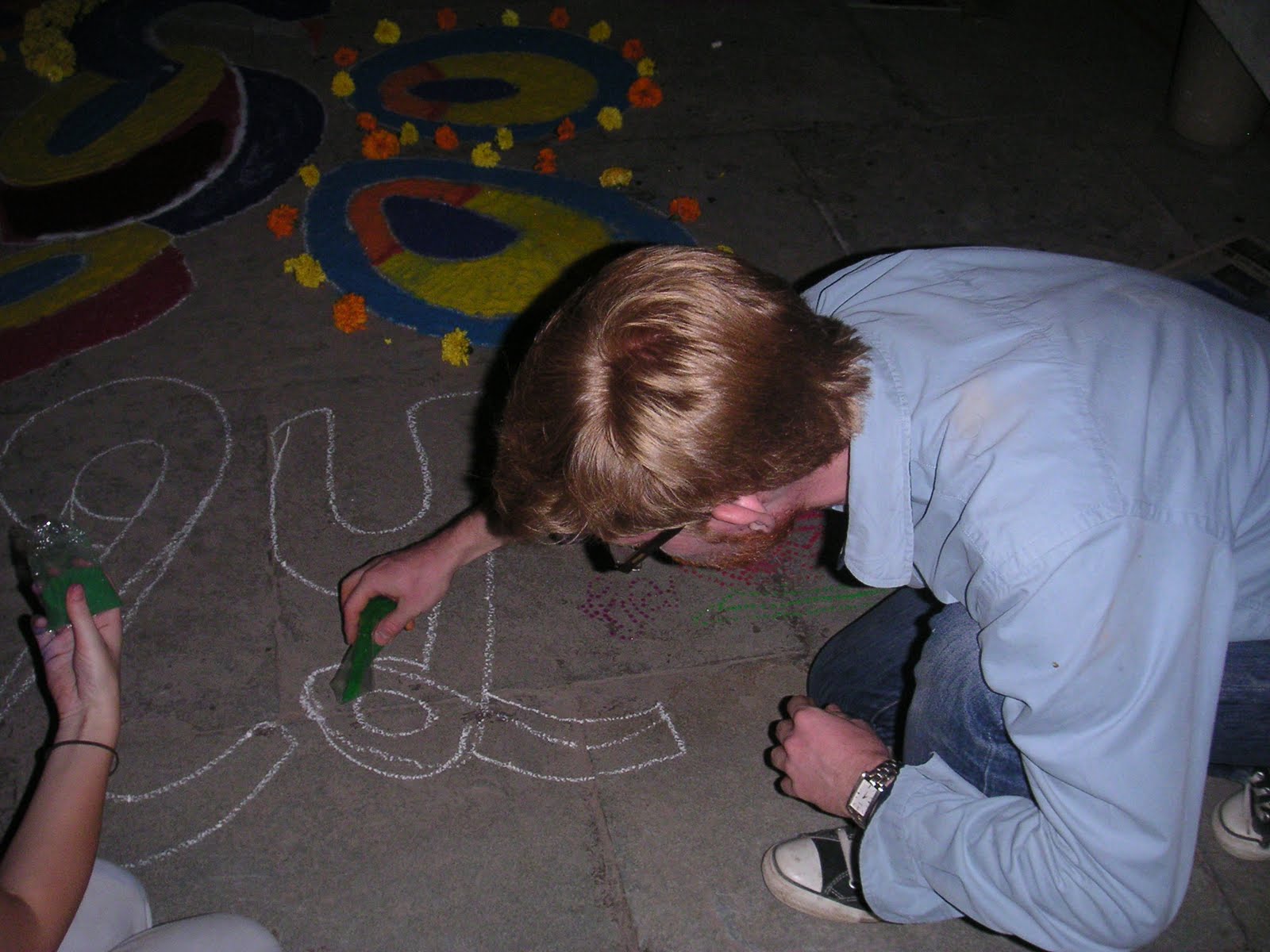
Decorating your home is an important part of Diwali and the campus cultural committee had organised a competition between the dorms. Among the things we did was a coloured sand image of a peacock, the process of creation showed in the pictures above. Being my first (and quite likely, only) sand image I must say I was rather pleased. Have in mind, the image is comprised of sand sprinkled on the floor only, there is no paint, crayon, glue or other tools to aid you. We did not win, however were awarded a special mention for outstanding effort by the panel of judges.

Monday, November 1, 2010

Day 4: Panjim


The nightly bus ride from Hospet to Goa's capital Panjim (or Panaji, as it is also known) proved to provide an endless array of jokes on the format "How many Israelis does it take to get off a bus?" and "How much time do x Israelis need to get off a bus and what will be their decibel level as they go along?" Goa is obviously a long-time favorite among backpackers and the bus made several stops along the way. These people were quite the stereotypes. Rasta plaits, cargo pants and mini drums in bands across the chest, which they to my regret enjoyed playing in the middle of the night. One was even wearing a t-shirt with the text "God created grass, man created booze. Who do you trust?". I would argue God also created toadstools, however that does not mean I intend to consume them. What troubled me the most, though, was the way one (the gentleman in the marijuana t-shirt) treated some beggars in Hospet. Yes, sometimes I too think beggars are annoying, but that does not in any way justify a condescending behaviour of yelling "shoo, shoo" with eyes wide open and accompanying hand gestures. It is, to put it mildly, not the way to behave when you are a guest in somebody else's country.

Upon arriving in Panjim, we were immediately stricken by the beauty of the town. By all Indian standards, it is clean, quiet and well behaved. The Portuguese heritage is extremely visible in everything from churches, secular architecture, clothes (especially the females') and, dare I say, mentality. This is not at all odd, considering the Portuguese did not leave (or rather, they were kicked out) until 1961. Panjim truly is a natural pearl among Indian cities.

After too much looking (thank you again, LP incomprehensible maps...) we found a very pleasant guesthouse, where we had planned to spend the night. After the best breakfast I have had since arriving in India (there was coffee, and no loads of added milk and sugar...) we set out to see Old Goa, the former capital, 25 minutes away by bus. Back in the days, this was no tiny colonial outpost; in fact, it had more inhabitants than both London and Lisbon. Due to some nasty and unfortunately recurrent outbreaks of malaria, it was however abandoned in 1835 and became what is best described as a ghost town (though it has lately been revived a little). Quite a spectacular one, I would imagine, considering that it is home to some pretty impressive buildings, including the Sé Cathedral - apparently the largest church in all of Asia. There is also the Basilica of Bom Jesus (which holds the remains of St. Francis Xavier), the Church of St. Francis of Assissi, the Chapel of St. Catherine and... well, to be honest there are very many churches in old Goa, but to come to their defence, they are all very beautiful. Something that moved me especially were the wrecked tombstones of 17th century Portuguese men and women, now since long forgotten, around the quiet Chapel of St. Catherine. I specifically remember one piece with a faint, though still clearly visible, fragment of a catholic bishop's crest. A peaceful and tranquilising final resting place they have been awarded. A stone's throw away lie the remarkable ruins of the town's Augustinian monastery. I have always had a soft spot for ruins of that kind and this was really one of the best I have seen.

After returning to Panjim we expored this town further, wandered its narrow streets up and down, discovered the wonderful, but tiny, Top Gear Pub and ate some truly terrific food at a hotel, the name of which I have by now forgotten. There is not much to tell about Panjim, because really it is not so much a town for exploring as for sensing. It has a rhythm of its own. It is best experienced in listening mode. A favorite of mine.

Pictured clockwise: Basilica of Bom Jesus; Panjim; Sé Cathedral; Augustinian monastery ruins

Friday, October 29, 2010

Days 2 & 3: Hampi


There is no way describing the awfulness of the road between Bengaluru and Hospet. Yes, it does indeed run from point A to point B, but that really is about it. To make it brief, it is full of holes. They are everywhere and they are huge. Every time the bus encountered one you would literally lose touch with the bed and hover in the air for a few tenths of a second before coming crashing down again. Not much sleep for any of us that night, that was for sure.

Our somewhat fragile condition upon arriving in Hospet in no way bothered the armada of ricksha drivers who put their heads through the windows and even entered the bus to offer their services for the last thirty minutes of our trip to Hampi. My evil me was happy to see their enthusiasm go away as soon as they found the bus company set out to foot the bill as it turned out we had in fact purchased tickets with Hampi, not Hospet, as our final destination. Bus company pays = less money than you can try to extract from a clueless foreigner. Touché. We teamed up with two French guys we met on the bus, one of whom had already once been to Hampi and was able to show us to the very pleasant Gopi Guesthouse, where we would be spending the coming two days.

After breaktfast, Thomas and I decided to cross the Tungabhadra River in order to see the Hanuman Temple, believed to be the birthplace of the monkey god with the same name. Just as in Bengaluru, our LP map was now to fail us miserably. Intuitively it seemed as if we were supposed to go left through the village of Virupapur Gaddi. After ten minutes of walking we decided to consult the map, just to be sure, and found the opposite was true. We walked back and continued in what we believed to be the right direction right until the moment the road was no more. Instead there was a field, with I believe rice growing all over it. Confusion was abound. A new look at the map (why do we keep trusting it?) seemed to indicate (once again, I pose this very question...) that we were in fact walking parallel with the road that goes past the temple and not very far from it - lucky us! If there only were a way to get across this mountain ridge that separated us...

So instead of going around the mountain, taking a ricksha, renting a bike or any other kind of perfectly sane option, we decided to cross it. It just seemed like a good idea at the time. Two hours or so later, after a brief encounter with a family of cows and what seemed like and endless zig-zagging between giant blocks of rock and impenetrable terrain and with an absolutely lethal sunburn, we emerged on the other side. The road was indeed there, but the temple still perhaps a kilometre away. After a comparatively easy walk along this dusty road, we could then climb the 570 or so steps up to the temple (the second mountain to climb that day, may I point out...), which suitably enough is populated not only by a priest and his television set, but also by very many monkeys.

After walking down again we teamed up with a Belgian guy to get back to the village and engulfed in a fascinating negotiation with a ricksha driver who considered each of us paying 30 rupees as too little, but grumpily accepted to take us there for a total of 80... And by the way, we very soon ended up at the exact location where we had decided to turn back again after consulting LP...

In the evening we had dinner at the wonderful Mango Tree restaurant. On our way back to the guesthouse it started to rain. Increasingly. Monsoon kind of rain. Soon everything was water. Water stood like a wall all around us and we were walking in it up to our ankles. Just to add to this perfect night, it was also completely dark, as we tried to navigate our way back to the guesthouse. Everything, absolutely everything, was completely soaked - money, LP, passports, cell phones, clothes, notebooks, shoes, whatever we had carried in our pockets and rucksacks. Trying to dry them during the night was an attempt that proved an utter failure in most cases, but let us not dwell on details here, as there are too many of them and they are sometimes quite painful.

The next day we stayed on our side of the river, in Hampi. Hampi truly is a spectacular place. It was once the capital of the mighty Vijayanagara Empire, which fell in 1565. At its peak, Hampi was a major trading centre with some 500,000 inhabitants. Now, it is merely a small village, the inhabitants of which in some cases have settled in the ruins. That does not matter for any visitors, because the area is almost covered by ruins, most of them very well preserved. The place is enormous and you really get a sensation of how large and vibrant this city must once have been. You are continuously running in to temples, bazaars, palaces, gardens, baths, elephant stables and other constructions that you simply have to go inside to have a look at. The road from the village to the architectural wonder of the Vittala Temple seems to take forever, even if it is only two kilometres, simply because of the distraction. I dare say I have never seen anything like it and I loved it. It is like Rome, but without most of the people.

Speaking of Mediterranean countries, that same evening we set out again, this time with our eyes on former Portuguese colony Goa.

Pictures from left to right: Hampi elephant stables; the 55 metre tall Virupaksha temple in Hampi; interior of the Queen's Bath; view from the Hanuman Temple; entrance to the Vittala Temple.

Thursday, October 28, 2010

Day 1: Bengaluru


Early Saturday morning, Thomas and I were sitting in an auto ricksha, bound for Ahmedabad airport. There, a
GoAir Airbus was waiting to take us to the city of Bengaluru, formerly known as, and still frequently called, Bangalore. It is no more than a two hour flight from Ahmedabad, but the differences between the two cities are huge. We only spent the afternoon and the evening there, so it would be a shame to say we got to know all the ins and outs of the city, but I can tell you this: Not a fan.

Yes, it by all measures more Western than probably any place in Gujarat. You can eat beef if you want to (and yes, we did - thank you Hard Rock Café). Most people do not find your skin colour exciting. And there is beer for anybody who likes it. So far so good, but still it is missing something. Charm is, I believe, the word that I am looking for.

Bengaluru is hectic, traffic is awful and the ricksha drivers refuse to go by the meter. Negotiating the price quickly gets tiresome, when the gentleman in front of you insists 250 rupees is the fair price to go to an address a few blocks away. (I do not think there are two places in India a ricksha drive in between of which would amount to 250 rupees...) There is really not that much to see. After an absolutely delicious Western lunch (Subway, but still) we went to see the not super exciting Tipu Sultan's Palace, from where we walked a considerable distance to the Bull Temple. That the distance covered on foot turned out to be this massive was mostly the result of Lonely Planet's Bangalore map clearly telling us to take a right, when in fact left was the answer. The LP maps were in fact to evolve into a continuous ordeal during our journey. To briefly summarise the Bull Temple, it was pretty cool, though oddly enough came with a corporate sponsorship.

A dinner even more Western in nature than the lunch left my stomach not really in uproar but still somewhat grumpy, as the sudden inflow of Hard Rock Café amounts of dead cow was something it was no longer used to. After what seemed like a long day, I was looking forward to the night sleeper to Hampi, which was supposedly only a few minutes away.

Private bus companies, unfortunately, do not leave from the main bus station in Bengaluru, from which only government buses are allowed. Instead, they leave from... well, other places. It is chaos. We had an approximate address (near a roundabout and a Ganesh temple) to help us locate the place, but this turned out to be far from the smooth ride you desperately want at that hour. Nice gentlemen kept pointing in completely opposite directions. Luckily (we thought...) we suddenly stumbled upon the bus company's office, where they pointed out a location about a hundred metres away, where the bus was supposed to pick us up. There, the people said they had never heard of any such bus and we were directed back to the bus company's office, where they then sent us back to the position from which we had so recently come. We decided to hold our position and hope for the best.

All of a sudden, my telephone rang. The man on the other end obviously spoke no English, a fact he tried to compensate for by instead talking louder than normally. After two failed attempts at communicating I was able to locate somebody who looked nice and well educated enough to be able to interpret whatever was coming out of my phone. As it turns out, the man with no English skills had simply wanted to tell me that our bus was five minutes late, which at this point really did not seem like a very big deal. All was more or less well and suddenly the bus even showed up. We hurried to get onboard only to find out that it was the wrong bus. Apparently, the people at the bus company office (how I do not fancy these people) had got the buses mixed up. Realising the mistake, we were taken to another stop, where the genuine, true and air conditioned Hampi sleeper coach was peacefully awaiting us. If only we knew then what to expect from the ride...

Stay put for days 2 and 3 on Hampi.

The pictures, some of which stolen from Thomas' memory card, show, from left to right: The exterior of the Venkatamaran Temple, which we unfortunately could not enter; the cow-inhabited interior of a temple we found while we were heading in the wrong direction to see the Bull Temple and which some children (pictured) showed us; and an interior of theTipu Sultan's Palace.

Friday, October 22, 2010

Off traveling


For the first time since I arrived in Ahmedabad I'll actually have more than two days off from school, providing me with some time to travel and discover other parts of India. So early tomorrow morning new-found friend Thomas and I will take a ricksha to the airport. We fly to Indias IT hub numero uno Bengaluru (Bangalore), where we'll spend the afternoon and evening. From there we take a sleeper coach to Hampi, an old village with many ruins. It's a world heritage and something we both have been wanting to see. We stay there for two days, upon which we catch a second sleeper to old Portuguese colony Goa. Having been to Macau earlier, I wonder to what extent the Portuguese heritage can still be experienced. Goa only gets one day, as we must hurry back to Ahmedabad for classes that start on Thursday. Update and pictures to come!

As I run through the valley of the shadow (not really...) of death


Today saw the IIMA 5 kilometer run. Anybody could participate and so they did. By the gates at the New Campus a masse of people had assembled at 5 o'clock, as stipulated. As always in India, the actual thing didn't start until at least 20 minute later. I'm not judging here; I just say things don't start on time.

Five kilometres is a relatively short distance, I think most people would agree. When temperatures have well exceeded 30 degrees Celsius, it doesn't seem so short. It was warm. It was sweaty. It was long. It was sometimes absolutely horrid. And in the end, it was over. I'm proud to say that the exchange students dominated and took places 1 through 4 among the males and 2 and 3 among the females, despite being the visiting team on the ground.

And I shall dwell in dorm 15 room 24 forever.

Pictured are happy contestants Hubert (France), Thomas (Switzerland), Ole (Norway), me and Pierre (France).